
Leadership Alignment: How Enterprise Leaders Move from Agreement to Alignment
Leadership alignment is the process by which an enterprise leadership team moves beyond surface-level agreement and commits to a shared way of leading, deciding, and delivering together. It’s not just alignment on what to do. It’s clarity on HOW the team will work together to make it happen.
Aligned teams don’t just agree in the room. They show up consistently outside it. Decisions get made faster. Execution becomes more disciplined. Priorities hold. When alignment is missing, the opposite happens. Priorities stall, decisions circle, and execution breaks down.
This guide breaks down what leadership alignment really means, the four dimensions required to build it, the signs it’s breaking down, and how enterprise teams turn alignment into sustained results.
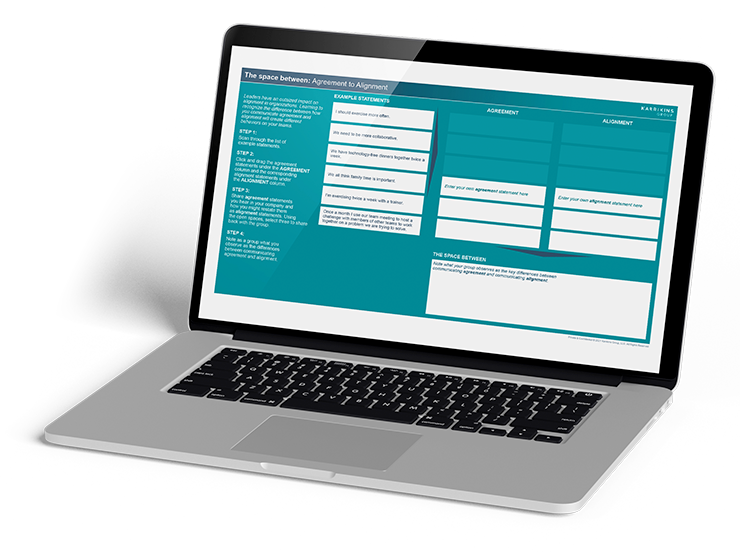
Download “The Space Between: Agreement to Alignment” to see how aligned leadership drives faster decisions, clearer priorities, and more consistent results.
Aligned Leader Articles and White Paper Resources
Check out our articles, white papers, and worksheets with more in-depth conversations on enterprise alignment and exercises to help leaders build alignment.
Breaking Free from Routine: 3 Tips for Improving Decision-Making Quality and Velocity in Leadership Teams
What is Servant Leadership?
4 Ways to Accelerate Organizational Transformation: Transforming Leaders To Succeed
5 Ways to Help Transformational Leaders Align: Actionable Steps to Align During Transformation
Video Resources on Alignment
Check out our HOW Activators as they share ideas and experiences in building alignment.
Energize Your Transformation: The Power of Leader Activation [Webinar]
The HOW of Leadership [Virtual Workshop + Worksheet]
The Failure Gap: the Space Between Agreement and Alignment [Whitepaper + Video]
Know Your Diamond Triangle Workshop: How to Deliver as a Team [Webinar + Worksheet]
What Does Leadership Alignment Look Like in Practice?
Leadership alignment shows up in daily operations as consistent decision-making, shared accountability, and unified messaging from senior leaders through every layer of the organization. Alignment isn’t a one-time outcome. At Karrikins Group, we see it show up or break down in how leaders operate every day, especially in how they make decisions, handle tension, and follow through together.
In aligned organizations, you’ll see:
- Leaders making decisions at the right level without escalating everything upward
- Consistent messaging from the top of the organization through every layer
- Productive conflict — teams debate ideas openly and then commit to a direction together
- Accountability that runs horizontally across the leadership team, not just top-down
- Strategies that translate into clear decisions, visible trade-offs, and consistent follow-through
In misaligned organizations, the symptoms look different: slow decision-making, leaders defending their own departments over collective goals, priorities that shift before they’re delivered on, and a persistent gap between what leadership says and what the organization experiences.
Research reinforces the cost of misalignment. McKinsey reports that aligned leadership teams are twice as likely to deliver above-average financial performance. And according to a Harvard Business Review study, 50% of executives cite poor alignment as a primary cause of slow decision-making. In Karrikins Group’s work with enterprise teams, the same pattern emerges consistently. Alignment shows up first in decision speed, then in execution, and ultimately in results. And when alignment is absent, the culprit is almost always the Failure Gap — the space between what leaders agreed to and what they actually changed about how they operate.
What Are the Signs Your Leadership Team Is Misaligned?
Leadership misalignment rarely announces itself. More often, it shows up as a pattern of symptoms that feel like execution problems or culture issues but have alignment at their root.
Watch for:
- Slow or circular decision-making: meetings happen, decisions don’t
- Inconsistent delivery — commitments are made but not followed through
- Reprioritization as a habit: new initiatives keep replacing existing ones before completion
- Lack of clarity on decision rights: who owns what keeps getting debated
- Leaders working in silos: teams optimizing for their function, not the organization
- Strategy-execution gap: good plans, poor follow-through
If several of these sound familiar, you likely don’t have a strategy problem. You have an alignment problem. Left unaddressed, it will continue to slow decisions, dilute execution, and limit growth.
What Is the Difference Between Agreement and Alignment in Leadership?
Agreement is when a leadership team verbally endorses a shared goal. Alignment is when every leader has changed their individual behavior, decisions, and habits to make that goal real.
What is something people say around your organization that starts with “if only we would….” or “we really should…”? The top 5 Karrikins Group hears most often include ‘collaborate’, ‘innovate’, ‘break down silos’, ‘make faster decisions, and ‘commit to our strategy’. Everyone agrees with these concepts, but very few people are willing to do the hard work to align with them.
Alignment requires leaders to determine how they need to lead differently to create new outcomes. It takes courage to start with self and determine how you will change before you try to change others.
That conversation is where the hard work of alignment starts.
Clarity, Connection, and Commitment: The Three Building Blocks of Alignment
At Karrikins Group, alignment is defined through clarity, commitment, and connection — and fueled by the courage to change yourself first.
Clarity brings focus and attention on how to lead individually and collectively to deliver on strategies, plans, and transformations. Too often, leaders are deeply invested in what needs to be done but fail to give equal energy to how they will change personally to deliver on it.
Leaders need a connection not only to the goals of the transformation, but also to each other as they take on the hard work as a team. Most enterprise leadership teams underleverage the power of the collective leadership experience. By working differently as a leadership team, executives can hold each other accountable to delivering a transformed organization.
Leaders must have a commitment to personally doing what needs to be done to transform. We often see leaders making commitments for others or exhorting their employees to commit to doing.
Beware The Failure Gap
The Failure Gap is Karrikins Group’s term for the space between agreement and alignment. It is where most enterprise transformations stall and often die.
The Failure Gap appears most often when executive teams reach agreement on priorities, strategies, or transformational changes without doing the hard work of aligning to what needs to be done. The bigger the change, the wider and deeper the Failure Gap grows. Everyone agrees that changes must happen. Then nothing changes. The same decisions, investments, and priorities are maintained across the organization. The desired transformation gets absorbed into the Failure Gap. Julie Williamson, PhD, wrote in depth about this pattern in Make HOW Matter.

Why Must Enterprise Leaders Do the Hard Work of Alignment?
Enterprise leaders must do the hard work of alignment because misalignment amplifies downward through every layer of the organization, slowing decisions, diluting execution, and widening the Failure Gap.
It takes a courageous leader to go first. No individual leader can close the Failure Gap alone. The most senior leaders in the organization must align and deliver together for transformation to succeed.
If it is so hard, why do it? In Karrikins Group’s work with enterprise teams — through programs like the Alignment Institute® and executive alignment coaching and advisory services — three main reasons to invest in the hard work of aligning leaders consistently rise to the surface:
- Financial opportunities are realized more quickly as cohesive and informed investments are made, and existing efforts are redirected to be inside the guardrails for alignment.
- The energy of employees is unified toward the desired end state. Nothing is more frustrating to employees than hearing one thing and seeing something completely different from leaders.
- Customer engagement and marketplace support for the transformation will increase significantly if customers and external stakeholders see leaders actively aligning their behaviors, decisions, language, and commitments to the transformation goals.
When senior leaders fail to change, they have an amplified impact on the rest of the organization.
Moving a team to alignment is a powerful leadership skill. It helps to:
- Reduce circular conversations about what should be done
- Accelerate momentum for transformation
- Create urgency and action on strategy
- Make it visible when priorities aren’t being resourced
If a leadership team is going to succeed at transforming the company, delivering on strategic priorities, and moving confidently toward the future, aligning horizontally to new ways of working
together is non-negotiable.
Download our free worksheet and explore what alignment might sound like with your own team.
How Do You Build Leadership Alignment? Five Steps That Work for Enterprise Teams
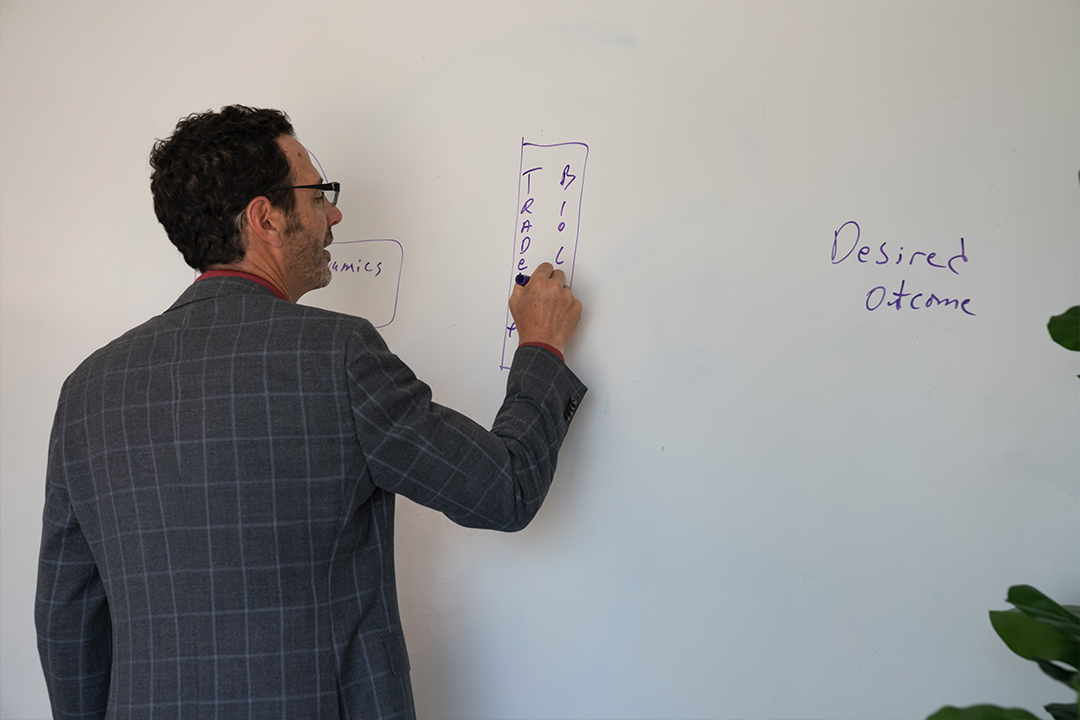
Building leadership alignment requires five steps: co-creating clarity on shared behaviors, acknowledging tradeoffs openly, sharing the struggle publicly, fostering mutual accountability, and insisting on transparency across the senior team.
Through our work at Karrikins Group, we help leaders to actively and visibly move from agreement to alignment. As we’ve worked across industries with companies of all sizes, we’ve found a handful of tangible actions that help leaders to do the hard work of starting with themselves to move to alignment. Five actions consistently rise to the top at organizations that succeed in moving into leadership alignment and delivering accelerated growth and amplified impact.
1. Co-Create Clarity
Knowing what alignment looks like in terms of decisions and behaviors can only be done collectively. This can drive some tough discussions about long-held relationships with suppliers, distributors, employees, and customers. It can also challenge individual leader autonomy and preferred projects. However, without these kinds of discussions, it is impossible for a leadership team to move forward in alignment. Karrikins Group’s Alignment Institute® provides a structured process for exactly this kind of co-creation.
2. Acknowledge Tradeoffs
Tradeoffs create tension in the systems of leadership that are most familiar and comfortable. They are natural – they will never go away, and the goal is not to fully resolve them. Instead, alignment requires recognizing when and where they are influencing decisions and how leaders respond to them. A common tradeoff is short-term results and long-term investments. There is no consistent right answer – tradeoffs are made every day in this space. Making the tradeoff visible and wrestling with it in a different way is a critical step in transformational alignment.
3. Share the Struggle
Leaders sometimes make the mistake of thinking that their job is to protect their people from change. In today’s business environment, where change is a constant, a leader’s highest order calling is actually to create change-able people. In doing so, leaders cultivate resilience and capability among their teams. One easy way to build this muscle is by sharing the struggle to change from the highest levels in the organization. When a leader says it is time the transform, the best way they can lead the charge is by telling their organization exactly how it will be hard for them to change and the hard work they are putting in to do so. Speaking from the heart and talking through how they navigate tradeoffs and personal preferences that are challenged by the new direction will make it real to people. This creates the groundswell that is needed across the organization as others start to model their thinking processes and ways of working.
4. Foster Accountability
Anyone who’s ever been on a diet knows that accountability is a key element of success. Leaders need to demonstrate to their organizations that they are being held accountable to their own change before they ask others to do the same – they can’t just hold others accountable; they must do the same for themselves. Accountability Coaches can work with leaders and their teams to set the conditions for alignment and help them to stay accountable to the new direction. It is very difficult to see habits, behaviors, and default settings that teams have settled on over the years. Having an outside eye on things can help make these visible and create safe and clear paths to change.
5. Insist on Transparency
Create processes that promote transparency across the most senior team. Transparency and accountability processes are less about status reports and more about comparing individual notes, sharing challenges, and being honest about how and why decisions are being made. Senior leaders, especially P&L owners, often work autonomously within their own budgets, and sharing information and insight with their colleagues might not be a natural practice. Building a new kind of sharing across the senior team will help drive transparency, create a sense of connection, and ultimately move the organization towards accelerated impact.
Frequently Asked Questions About Leadership Alignment
What is leadership alignment?
Leadership alignment is the shared commitment of an enterprise leadership team to how they lead, decide, and deliver together.
It goes beyond agreeing on goals. Alignment shows up in consistent behavior. Leaders make decisions the same way, reinforce the same priorities, and follow through together. When alignment is real, the organization feels it in how work actually gets done.
Why does leadership alignment matter?
Because strategy doesn’t fail on paper. It fails in execution.
When leadership teams are aligned, decisions get made faster, trade-offs are clear, and execution becomes more consistent across the organization. When they are not, teams stall. Priorities compete. Progress slows.
Alignment is what turns good strategy into real results.
What is the difference between agreement and alignment?
Agreement is what happens in the meeting. Alignment is what happens after.
Leaders can agree in the room and still leave with different interpretations, priorities, or actions. That is where execution breaks down.
Alignment means leaders leave the room and operate the same way. Decisions stick. Messages are consistent. Follow-through is shared.
What are the signs a leadership team is not aligned?
Misalignment rarely shows up as a single issue. It shows up as patterns.
You might see slow or circular decision-making. Priorities that keep shifting. Teams starting work but not finishing it. Leaders protecting their function instead of the enterprise. A gap between what is said and what actually happens.
Most teams experiencing these symptoms do not have a strategy problem. They have an alignment problem.
How long does it take to build leadership alignment?
Alignment is not a one-time event. It is a way of operating that teams build over time.
That said, most enterprise teams begin to see meaningful shifts within a few months. Decision-making becomes clearer. Conversations become more direct. Execution starts to stabilize.
Sustaining alignment requires ongoing attention, but progress shows up faster than most teams expect.
What does leadership alignment actually look like in practice?
You can see alignment in how a leadership team operates day to day.
Decisions are made at the right level and do not get revisited repeatedly. Leaders communicate consistently across the organization. Debate is open and productive, but once a decision is made, the team commits to it.
There is clarity on priorities, ownership, and trade-offs. Execution moves forward without constant resets.
What are the four dimensions of leadership alignment?
At Karrikins Group, alignment is built across four dimensions:
- Clarity – A shared understanding of how the team leads and what matters most
- Connection – Trust-based relationships that allow leaders to challenge and support each other
- Commitment – A willingness to change behavior, not just agree in principle
- Courage – The ability to have the hard conversations required to stay aligned
When these four are present, alignment becomes sustainable. When one is missing, execution starts to break down.

The Alignment Institute® is Karrikins Group’s premier leadership program, built on four dimensions of alignment — Clarity, Connection, Commitment, and Courage — to help enterprise teams move beyond agreement into sustained results.
Moving from agreement to alignment requires leaders to change how they actually work together.
It shows up in how decisions get made, how tension is handled, and how teams follow through. Those patterns are often deeply ingrained, which is why alignment is harder than it looks. But when leaders go first and change how they lead, the impact shows up quickly in how the organization operates.
At Karrikins Group, we focus on helping enterprise leaders make HOW they lead together the differentiator. Because the gap between strategy and results is rarely about what to do. It’s about how leaders show up and work together to get it done.
Karrikins Group Case Studies
No Results Found
The page you requested could not be found. Try refining your search, or use the navigation above to locate the post.