
Empowered To Fail: Using Mistakes To Support Leaders’ Growth
Originally published in Forbes on July 31, 2026. Read the original.
Key Takeaways
- Empowering leadership means giving next-level leaders real authority to make decisions and the safety to fail, then helping them learn from it. Empowerment without the safety to fail and learn isn’t really empowerment.
- If people are only allowed to make the “right” decisions, they aren’t empowered. They’re working inside a process so tightly controlled that they can’t go wrong.
- Julie Williamson, PhD, names six facets of empowering next-level leaders: give clear decision authority, get out of the way, be a resource rather than an arbitrator, offer options as data points, push critical thinking and stay supportive whatever the outcome.
- A culture of learning starts with leaders who make their own mistakes visible and ask about failures without judgment, while still separating learning moments from chronically bad choices.
I work with senior leadership teams in all sorts of businesses, helping them define how they want to work and lead together. There are some consistent themes I see come up around the challenges of prioritization, accountability and trust across the team. I love leaning into the challenge of answering the question, “How are we going to lead differently so that we are better in those areas?” That’s usually where teams move from agreeing that something is a good idea to getting aligned and leading differently together.
However, there is a fourth, pernicious issue that comes up for almost every team: empowerment. This usually refers to the next level of leaders in the organization and how they are empowered to make decisions, take action or solve problems without senior leader involvement. Sometimes the issue of empowerment shows up as delegation—another word that is easy to agree to and hard to align with as a leadership team.
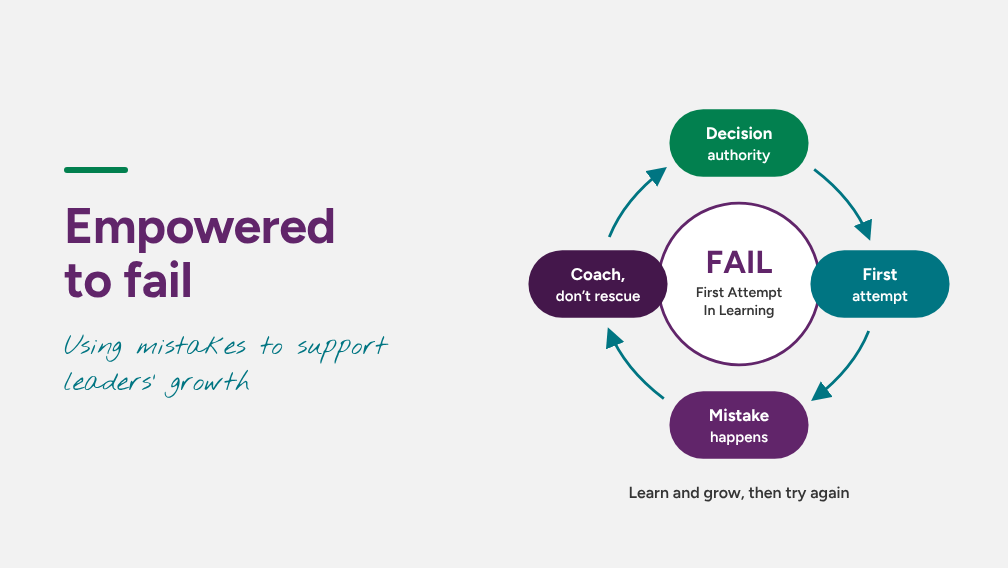
On my podcast, I recently had a conversation with Justin Salisbury, COO and president of a car wash company, about his approach to leadership. He told me about his philosophy that empowerment means giving people the opportunity to fail and then helping them quickly learn and grow from that experience. As he explained five and a half minutes into the interview, he subscribes to the idea that “FAIL” stands for First Attempt In Learning. He teaches his leaders to view their role as helping people through failure, not preventing it from happening or just fixing things when it does. I really appreciated this perspective because empowerment without the safety to fail and learn isn’t really empowerment at all.
Empowering the next level of leaders—or delegating decisions downward—sounds beneficial for everyone. Customers can get faster resolutions, senior leaders can gain capacity to focus on strategic priorities and emerging leaders can receive real decision-making authority and responsibility. But if people are only empowered to succeed or make the “right” decisions, they are not truly empowered. They are simply operating within a process so tightly controlled that they cannot go wrong.
A Practical Framework For Empowering Your Team
Before you decide that you need to empower your team to make decisions, take actions and move forward without you, do a gut check. Are you really willing to let them fail? Are you willing to stand beside them as they work through those failures? Or does it make you a little queasy to think about what might happen if someone on your team fails? Do you know yourself well enough to recognize that you might have a habit of swooping in to save the day if someone makes a mistake, instead of coaching them through solving the problem they’ve created?
In my experience, there are six important facets to empowering next-level leaders:
- Give them clear decision authority over something. This might be budgets, resources, priorities, client responses, etc.
- Get out of the way as they struggle to figure out a path forward. Growth and learning are hard, and people typically need some time and space to get there on their own.
- Be a resource, not an arbitrator, when a tough decision needs to be made. This is a tough place to be in, so consider starting them off with decisions about things with low-to-medium risk consequences.
- Highlight options and possible outcomes based on your experience. Provide these as data points, not the answer.
- Push them to think critically. Ask hard questions in a generative way that helps expand their perspective.
- Be supportive, regardless of the outcome. Support them even if the decision or action they land on isn’t exactly what you would do in the same situation.
Empowering your leaders also gives you the opportunity to watch them grow and thrive as they have the successes that come with ownership and responsibility. That’s the fun part of it! But you very likely won’t get that without a little hardship and a few missteps along the way, for both you and your next-level leaders. Of course, if someone makes a lot of mistakes, there should be consequences, so you also need to differentiate between learning moments where people can grow stronger and chronically bad choices that indicate someone isn’t ready.
Creating A Culture Of Learning
If you want to free up your own capacity and start depending more on your team to handle key parts of the business, your job is to create a culture where people know they can make their own decisions and be supported when they make a mistake. My conversation with Justin inspired me to reflect on a couple of additional takeaways that are also supported by my own work with leaders:
Have the courage to make your own mistakes visible to others.
Share your decision-making processes with your team, and let them know that you, too, have learned and grown from your mistakes. When leaders do this, the shift in people around them can be extraordinary. Teams often start to really embrace the opportunity to take on more because they know they don’t have to be perfect. I’ve seen it myself in my own development as a CEO!
Normalize asking people about their failures and genuinely listening to what they say without judgment or correction.
Have a conversation about the situation and the alternatives for moving forward, but let them pick themselves up and figure out how to fix what went wrong. Your job as a leader isn’t to protect them; it is to help them grow. And that only happens when you are willing to let them fail. Many of my clients struggle with this, but I’ve observed that the ones who figure it out tend to build the strongest followerships.
Final Thoughts
Empowerment isn’t for the weak-hearted leader. You need to be committed to developing next-level leaders through both success and failure in order to empower them to lead in your organization. If you can do that, you can unlock enormous potential across your team, have more time to work on new ideas for the business and help your next-level leaders experience new levels of growth and contribution.
Frequently Asked Questions
What is empowering leadership?
Empowering leadership means giving the next level of leaders the authority to make decisions, take action and solve problems without senior leader involvement, plus the safety to fail and learn when they get it wrong. Julie Williamson, PhD, argues that empowerment without that safety isn’t really empowerment at all. If people are only allowed to make the “right” decisions, they are simply operating within a process so tightly controlled that they can’t go wrong.
How do you empower your team?
You empower your team by giving them clear decision authority and then supporting them as they learn, including when they fail. Julie Williamson, PhD, describes six facets: give clear decision authority over something, get out of the way while they find a path, be a resource rather than an arbitrator, share options and possible outcomes as data points rather than the answer, push them to think critically and support them regardless of the outcome. She suggests starting with low-to-medium risk decisions.
What does FAIL stand for in leadership?
FAIL stands for First Attempt In Learning. Julie Williamson, PhD, discussed the idea on her podcast with Justin Salisbury, COO and president of a car wash company. He teaches his leaders that their role is to help people through failure, not to prevent it or just fix things when it happens. Julie’s view is that empowerment without the safety to fail and learn isn’t really empowerment.
Is delegation the same as empowerment?
Delegation is often how empowerment shows up in practice, by delegating decisions downward to the next level of leaders. Julie Williamson, PhD, notes that delegation is easy for a leadership team to agree to and hard to align on. The test is the same for both. If people are only empowered to succeed or make the “right” decisions, they aren’t truly empowered.
How do leaders create a culture where it’s safe to fail?
Leaders create it by making their own mistakes visible and by asking people about their failures without judgment or correction. Julie Williamson, PhD, has seen teams take on more once they know they don’t have to be perfect. Leaders still need to tell the difference between learning moments, where people grow stronger, and chronically bad choices that show someone isn’t ready.