
Why Your Collaboration Efforts Are Failing
Originally published in The CEO Magazine on December 4, 2024. Read the original.
Key Takeaways
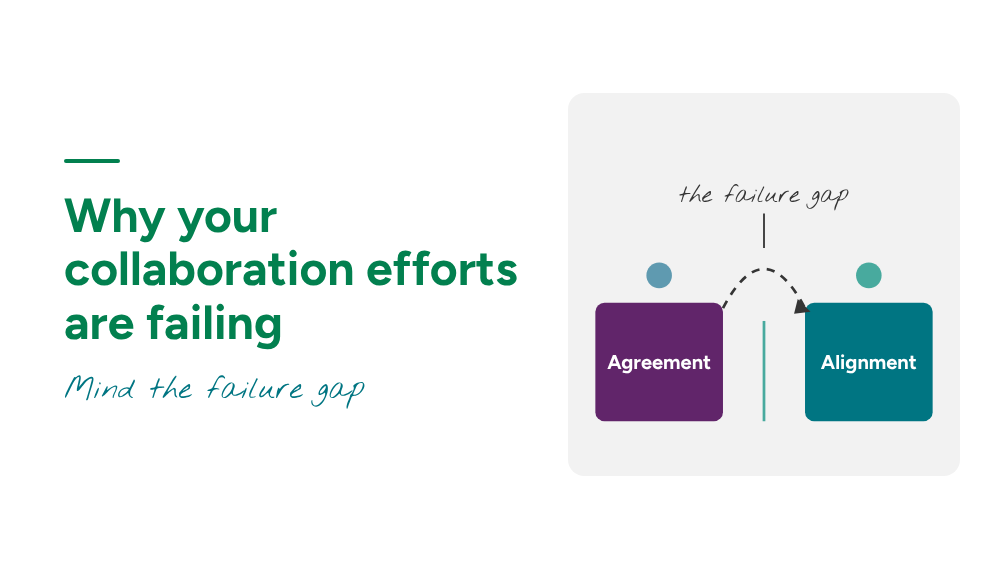
- Collaboration efforts fail when leaders agree it’s a good idea but never act on it. Julie Williamson, PhD, calls this the failure gap: “the space between agreeing that something is a good idea and aligning to make it happen.”
- The cause is usually unspoken mindsets about control, power and autonomy.
- Collaboration is smart when it creates shared learning, surfaces opportunities and risks between parts of the business, streamlines investments, has clear boundaries and is well facilitated.
- Before collaborating, ask four questions, especially: “What beliefs do we have that will hold us back from doing it?”
When I heard a client tell me that she thought collaboration was dumb, I was momentarily dumbstruck. Then I realized it was a golden opportunity to get deeper into the unspoken mindsets that hold people back from collaborating more. I think the truth is that a lot of people share that opinion, even if they aren’t willing to say it out loud.
Let me share a little bit more about my client. I’ll call her Amanda here, and she was the senior vice president (SVP) over a large geography for a national bank in the United States. Her comment came after a long conversation with the other SVPs at the bank about the importance of collaborating more across the company.
Afterwards, I was debriefing with her, and she dropped her guard a little and started sharing her frustrations about the discussion she’d just had with her peers. She pointed out that they’d had the same conversation many times, and everyone agreed that collaboration was a nice idea and was something they should try to do, but that they never really did anything about it.
Then she dropped the corporate-speak and got real with me.
“I have no intention of including other people in the decisions I make about my geography. Why would I? They don’t understand the local issues I’m dealing with; they act like if I ask for input, I’m going to let them make the decision, and my biggest priority is to deliver on my area’s goals while everyone else does the same in their areas,” she said.
“I think everyone should spend a little more time buttoning up their own space and a little less time trying to get into mine. I think collaboration is dumb. It is a waste of time and energy that is better spent elsewhere on the business.”
Does that sound at all familiar to you? Is it possible that it might even mirror your own inner dialog? Agreeing that collaboration is a good idea and then not doing it is one of the most common failure gaps I see when I work with enterprise-level leaders.
I think Amanda was the first (and to date the only) person I’ve ever talked to who was absolutely honest with me about her feelings on collaboration and why she agreed that it sounded like a good idea but had no intention of putting it into practice.
Conditions for collaboration
Here’s the thing. When people aren’t willing to make their mindsets, beliefs and assumptions visible, there isn’t any way to work with them effectively. In Amanda’s case, what she put out there was a very specific view of what collaboration is and why it is problematic. Because she was willing to say it out loud, at least to me, we were able to start a dialog about it.
In doing so, she and I came to more fully understand her resistance. It was well grounded in past experiences and observations, and it made a lot of sense in her context.
Believe it or not, I told her I agreed with her – collaboration is dumb when it is about getting in other people’s business, talking about things you don’t understand, and thinking that someone inviting you into a conversation is the same as them giving you decision rights.
So what are the conditions under which collaboration is smart? I’d suggest the following:
- When it creates the space for shared learning and understanding across the whole business
- When it helps drive the identification of opportunities and risks that exist in the white space between lines of business and functional areas
- When it streamlines investments in technology, marketing or other operational costs
- When the boundaries and expectations are clear
- When it is well facilitated, possibly by someone who isn’t a part of the power structure
Defining expectations
Too often, senior leaders talk about ‘collaboration’ without taking the time to define what it really means to them as a team.
As a result, it is left up to individuals to try to figure it out. I’ve had people say to me, “I asked Bob in the hallway what he thought of my idea, so I collaborated” or “I told the people on my team to check in with the other geographies, so they are collaborating,” but these casual interactions are not sufficient for the full value of collaboration to be delivered.
And there are plenty of people like Amanda who keep their thoughts to themselves but have no intention of doing anything with their colleagues unless they absolutely have to.
Here are four questions you can ask the next time the topic of collaboration comes up for you to create a better shared understanding of what is meant and what the expectations are:
- What is the outcome we hope to deliver by doing this?
- Why do we expect our outcomes to be better if we do this than if we don’t?
- How are we going to do this together?
- What beliefs do we have that will hold us back from doing it?
The last question is the one most teams don’t get to, and it is the one that keeps collaboration in the failure gap, the space between agreeing that something is a good idea and aligning to make it happen.
But if you lean into the difficult discussions and start to understand what people are assuming about collaboration, you will be able to address their human-centric concerns about control, power, and autonomy in ways that will help you to break through into aligned leadership.
It is a worthy discussion that drives big outcomes because it helps people to better connect with each other and to understand how to lead and work together.
Frequently Asked Questions
Why does collaboration fail?
Collaboration usually fails because leaders agree it’s a good idea and then never act on it. Julie Williamson, PhD, calls this one of the most common failure gaps she sees when working with enterprise-level leaders. The root cause is often unspoken mindsets, beliefs and assumptions, including concerns about control, power and autonomy. Until people make those beliefs visible, there isn’t any way to work with them effectively.
What’s the difference between agreement and alignment?
Agreement means leaders say something is a good idea. Alignment means they commit to making it happen together. Julie Williamson describes the space between the two as the failure gap: “the space between agreeing that something is a good idea and aligning to make it happen.” Collaboration often stalls there, when everyone agrees it’s valuable but individuals keep their reservations to themselves.
What is the failure gap?
The failure gap is “the space between agreeing that something is a good idea and aligning to make it happen,” a term Julie Williamson, PhD, uses in her work with leadership teams at Karrikins Group. Teams stay in the failure gap when they skip the hard conversation about the beliefs holding them back. Leaning into that discussion helps leaders address concerns about control, power and autonomy and break through into aligned leadership.
When is collaboration worth it for leadership teams?
Julie Williamson suggests collaboration is smart when it creates space for shared learning across the business, helps identify opportunities and risks in the white space between lines of business and functional areas, streamlines investments in technology, marketing or other operational costs, has clear boundaries and expectations, and is well facilitated, possibly by someone outside the power structure. It is “dumb,” she says, when it means getting into other people’s business or mistaking an invitation for decision rights.
What questions should leaders ask before collaborating?
Julie Williamson recommends four: What is the outcome we hope to deliver by doing this? Why do we expect our outcomes to be better if we do this than if we don’t? How are we going to do this together? What beliefs do we have that will hold us back from doing it? The last question is the one most teams don’t get to, and it’s the one that keeps collaboration in the failure gap.