
The Potential Pitfalls Of Collaboration—And Why Connection Is Key
Originally published in Forbes on March 25, 2026. Read the original.
Key Takeaways
- Enterprise leadership depends more on connection than on more collaboration. Leaders with a clear connection to the enterprise perspective can make decisions with the whole picture in mind, so collaboration becomes a natural outcome instead of a time vacuum.
- When collaboration becomes the default instead of a deliberate choice, it can spiral into a consensus culture of slow decisions, meeting fatigue and unclear ownership.
- Collaboration still works when it is well facilitated, pointed at an important but not urgent problem, used to plan across enterprise initiatives or used for ideation.
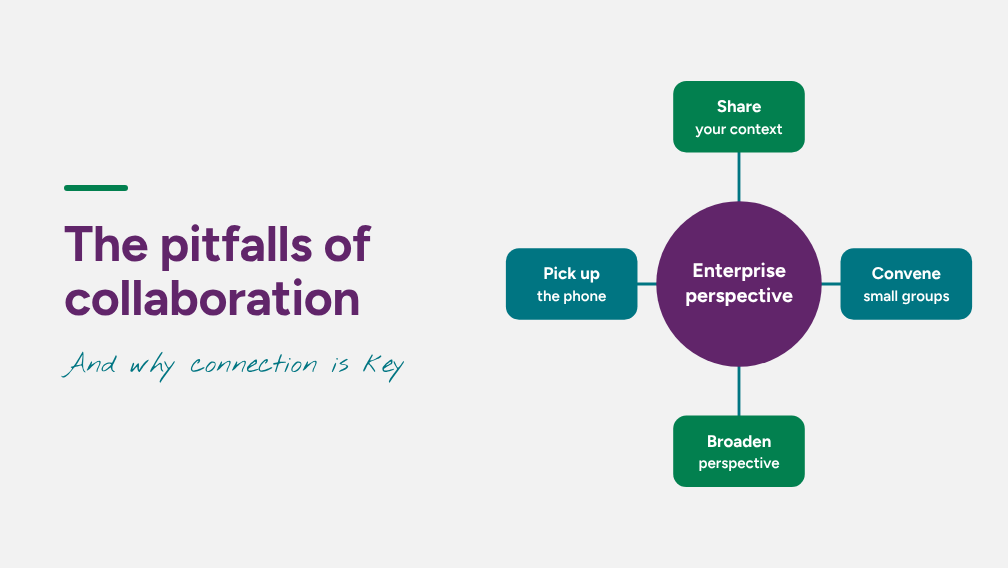
- Connection is built in small, consistent doses: share your context, convene small groups, help next-level leaders see enterprise impact and pick up the phone.
I think that if I had a dollar for every time a client said to me, “We need to collaborate more around here,” I could afford to be a space tourist. Through my work in consulting, I’ve found it is a persistent ambition that is very rarely realized in business.
And when it is realized, collaboration often becomes the default instead of a deliberate choice, which introduces its own set of challenges by spiraling the business down into a consensus culture.
When Collaboration Doesn’t Work
There are several reasons I’ve become skeptical of how organizations approach collaboration:
- People often have very different ideas about what collaboration means. Even after working hard to create shared meaning, deep-seated assumptions, expectations and beliefs are hard to overcome.
- Sometimes, collaboration becomes an excuse for inaction as people wait for the perfect time to get everyone together to collaborate on a solution.
- Collaboration can result in subpar and slow decisions by a committee on issues that require more alacrity in action.
- Collaboration is sometimes weaponized as people use it as a reason to disengage. I’ve seen some simply say, “Well, you didn’t collaborate with me on this, so I’m not on board.”
A fifth reason is that collaboration, as many leaders define it, simply isn’t as necessary as we sometimes make it out to be. Collaboration is resource-intensive even in its lightest forms: It requires investment, energy and time from people who are often short on all three. Moreover, I’ve observed that the outcomes of collaborations are not always better than what could have been achieved with far fewer people and resources. Sometimes, they are worse because solutions become committee exercises where too many compromises are made and solutions are watered down into what is most palatable to most of the people in the room, instead of the best solution for the situation.
One team I know went all-in on collaboration and found themselves convening a full-team collaboration session for every cross-functional decision they had to make. The result? After about a year, they were burned out on having pre-meetings, preparing materials and spending time in expensive sessions with the whole team making decisions that should have been made by, at most, two or three people. In my experience, it isn’t uncommon for organizations to over-index on collaboration and find that, instead of tightly aligned teams working together, they end up with slow decisions, meeting fatigue and unclear ownership of issues and outcomes.
When Collaboration Can Be A Good Thing
I’m not totally down on collaboration, though. When it is well-facilitated and structured, I think it is important and impactful:
- Collaboration can be a crucial step in getting everyone on board with a new direction. When people participate and feel included, they are more likely to support a decision.
- When it is well-organized, intentionally facilitated and pointed at a specific problem—one that is not urgent but is important—collaboration works great.
- It is often a vital part of planning and prioritizing across enterprise initiatives and getting to a direction that everyone understands because participation drives clarity.
- Collaboration also has a place in innovation and ideation sessions where big ideas are being explored and multiple viewpoints help expand the set of possibilities without needing to make a decision quickly.
Fostering Connection Across An Organization
So, collaboration still matters, but what I’ve observed people often need more of is a clear connection to the enterprise perspective, not simply more collaboration. This can help them make decisions with the whole picture in mind. Fueling and fostering connection across enterprise leaders creates an environment where visibility, understanding and commitment are a natural outcome of the culture, rather than an activity-based and time-intensive requirement to collaborate in a formal way.
Building that level of connective fiber requires small doses of consistent interactions over time that give people the broader understanding that is required of enterprise-level leaders. To do this as a leader, you can:
- Share your own context and understanding with others. By ensuring leaders throughout your organization are current on the priorities, challenges and wins happening across the business, enterprise leaders can more quickly and effectively participate in shared decision making when needed.
- Convene small groups that can move quickly and effectively. At the same time, ensure enterprise perspectives are included in critical decisions. Depending on the situation, this could include cross-regional or cross-functional people who can help tie decisions to the enterprise strategy.
- Help next-level leaders have a broad perspective on the business impact of their decisions. This is especially important in a matrixed structure where priorities often impact one another. Leaders can simply take an extra few minutes to talk with colleagues about what went into a decision and how enterprise impacts were considered. This helps everyone maintain the bigger picture.
- Connect with colleagues. Simply pick up the phone and call a colleague when they need to know if there’s a potential cross-organizational impact. Often, a 10-minute phone call can resolve what might otherwise trigger a 12-person, hour-long meeting in some organizations.
If you are struggling with collaboration in your organization, either because there isn’t enough of it or there’s too much of it, try refocusing on building connections across the business. Fuel those connections with meaningful content that helps leaders feel comfortable asking for advice, getting input from peers and incorporating ideas from diverse sources. That can help them make decisions that are in the enterprise context while maintaining decision velocity and acuity.
You might find that you don’t actually need to collaborate more after all. You just need to build a culture of connection that makes collaborating a natural outcome instead of a time vacuum for your people.
Frequently Asked Questions
What does enterprise leadership require?
Enterprise leadership requires a clear connection to the enterprise perspective, so leaders can make decisions with the whole picture in mind. Julie Williamson, PhD, says that broader understanding comes from small doses of consistent interaction over time, not from more formal collaboration. When leaders stay current on the priorities, challenges and wins across the business, they can take part in shared decision making more quickly and effectively.
What is the difference between collaboration and connection?
Collaboration is a formal, resource-intensive activity, while connection is the ongoing visibility, understanding and commitment that lets leaders decide with the enterprise in mind. Julie Williamson, PhD, argues that people often need more connection, not simply more collaboration. A culture of connection makes collaborating a natural outcome rather than an activity-based, time-intensive requirement for your people.
What are the signs of too much collaboration?
Slow decisions, meeting fatigue and unclear ownership of issues and outcomes are the common signs. Julie Williamson, PhD, describes one team that convened a full-team session for every cross-functional decision. After about a year, they were burned out on pre-meetings, preparing materials and expensive sessions making decisions that should have been made by, at most, two or three people.
What is a consensus culture?
A consensus culture is what can happen when collaboration becomes the default instead of a deliberate choice. Julie Williamson, PhD, warns that solutions then become committee exercises. Too many compromises get made, and solutions are watered down into what is most palatable to most of the people in the room instead of the best solution for the situation.
How can leaders build connection across an organization?
Leaders build connection through small, consistent interactions over time. Julie Williamson, PhD, recommends four practices: share your own context on priorities, challenges and wins; convene small groups that can move quickly while including enterprise perspectives; help next-level leaders see the business impact of their decisions; and pick up the phone when a colleague may need to know about a cross-organizational impact. A short call can often replace a much larger meeting.